Why Japanese keyboards are popular overseas
HHKB (Happy Hacking Keyboard) and Realforce both use Topre electrostatic capacitive switches, made in Japan. Typists who try them tend to describe the same things: a deep, soft key feel, quiet bottoming-out, and build quality meant to last for years of daily work.
A different switch, not just a different brand. Most premium keyboards overseas use mechanical switches. Topre switches are a hybrid design found almost only in Japanese-made boards, which is exactly why enthusiasts import them instead of buying locally.
Small, focused layouts. The HHKB is a compact 60% board with a cult following among programmers. Realforce offers full-size and tenkeyless boards aimed at long, comfortable typing sessions. Both lines are designed in Japan, and the flagship models are manufactured there.
Buying from Japan has real advantages. Some variants are sold only on the Japanese market — Japanese JIS-layout models, certain keycap legends and colorways, and limited editions. Japanese retail prices for domestic models can also be lower than overseas reseller prices, although shipping and import charges narrow that gap. Compare the full landed cost, not just the sticker price.
Three ways to buy from Japan
All three routes work. The right one depends on whether the model you want is current, Japan-only, or discontinued.
Direct international shops
Japanese stores that ship overseas with English checkout are the simplest route for new, current models. CDJapan, better known for music and games, also carries Japanese electronics and peripherals and ships to over 200 countries. You pay the item price plus international shipping, and the shop handles export for you.
Proxy buying services
Many Japanese shops — including the manufacturers' own Japanese stores and domestic retailers — do not ship abroad. A proxy (buying agent) service in Japan orders the item for you, receives it, and forwards it internationally. This is usually the only route to Japan-only models and domestic limited editions. Expect a service fee plus domestic and international shipping on top of the item price; check the fee schedule before ordering.
Used keyboards on eBay
Discontinued HHKB and Realforce models, and older Topre boards, circulate widely on eBay from Japanese sellers. Topre switches age well, so a used board in good condition can be a sensible buy. Check the listing photos for keycap shine and yellowing, confirm the exact model number (see below), and factor shipping into the total.
Which route should you choose?
Current model, sold internationally → direct shop. Japan-only model or limited edition → proxy service. Discontinued model → used marketplace. If two routes offer the same board, compare the total cost including shipping and likely import charges, not the item price alone.
Customs, shipping, and the fine print
US buyers: the $800 duty-free rule is gone. Until August 2025, parcels under US$800 entered the US duty-free under the "de minimis" exemption. That exemption was removed on August 29, 2025, so even small orders from Japan can now incur import duties, plus possible carrier handling fees. Budget for this when comparing prices — a board that looks cheaper in Japan may not be once duties are added. Rules in other countries differ; many charge VAT or GST on imports. Always treat tax figures as estimates and check your country's current rules.
Shipping is a real part of the price. A keyboard is light but bulky enough that international shipping (EMS, DHL, FedEx or similar) adds a noticeable amount, and proxy orders pay shipping twice — domestic within Japan, then international. Get the shipping estimate before committing, especially with proxy services, where the international leg is often calculated after the item arrives at their warehouse.
Delivery times vary. Direct shops usually ship within days. Proxy orders take longer — the item must reach the warehouse first. Used items from individual sellers vary by seller. If you need the board by a specific date, order with slack.
Fakes and model numbers
Two problems catch out import buyers more than any others: counterfeit or misrepresented boards, and near-identical model numbers that are not the same keyboard.
Check the exact model number. HHKB and Realforce lines include variants that differ in connection (USB wired, Bluetooth, or hybrid), key feel (standard or silenced "Type-S"), key weight (Realforce models come in different gram ratings), and layout (US ANSI or Japanese JIS). The model number — printed on the label on the back of the board — encodes these differences. In any listing, match the full model number against the manufacturer's Japanese product page before buying.
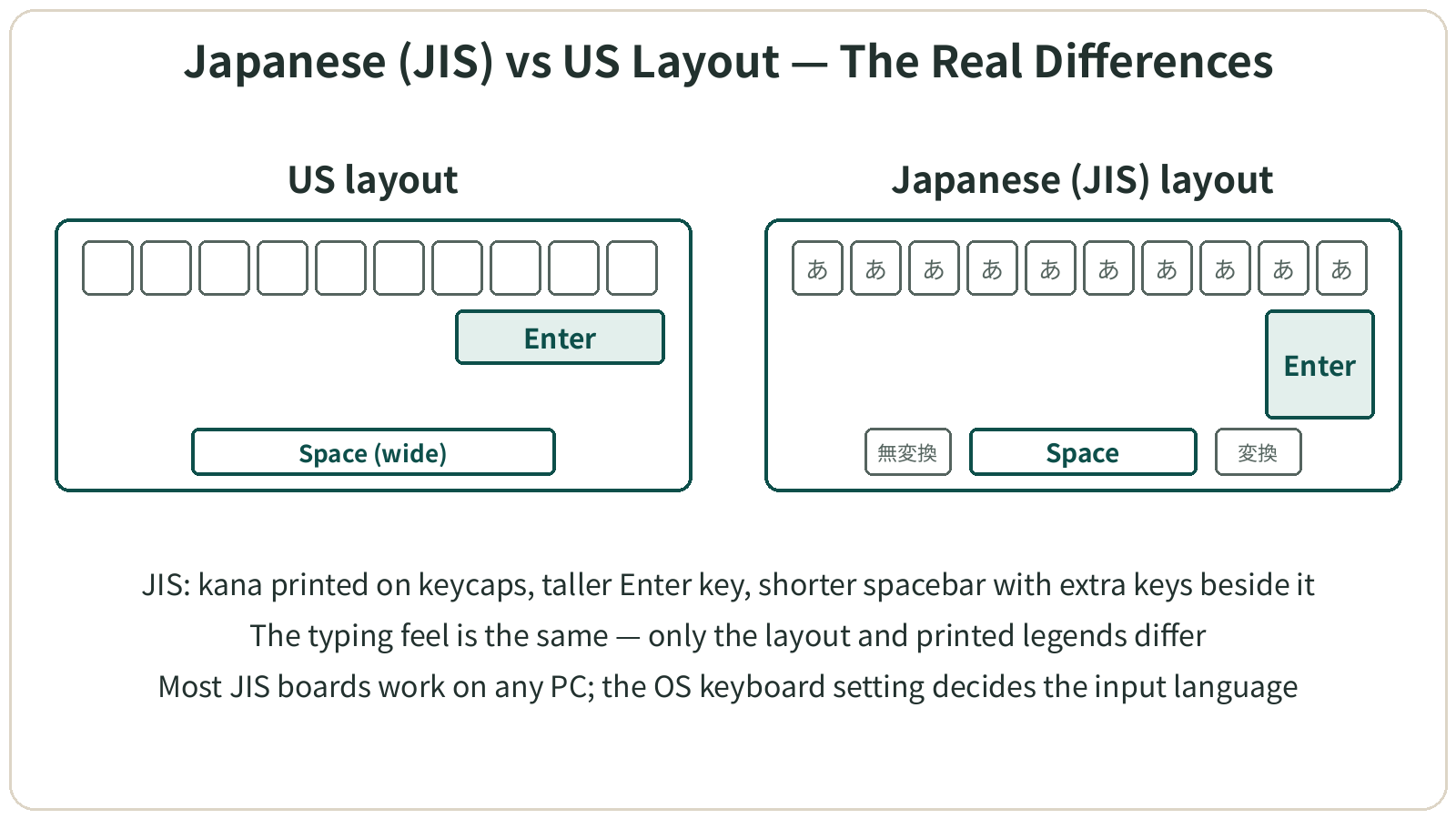
JIS layout is a real difference, not a cosmetic one. Japanese-layout models have a smaller spacebar, extra keys around it, and different punctuation positions. Great if that's what you want; a daily annoyance if you ordered one by accident. Listing photos of the key layout settle the question — look at them.
Be careful with suspiciously cheap "new" boards. Genuine HHKB and Realforce keyboards are rarely discounted heavily. Prices far below the Japanese retail level, stock photos instead of photos of the actual item, and sellers with little history are all reasons to walk away. On marketplaces, prefer sellers who show the model label and the actual board from several angles.